Neural machine translation (NMT) is the AI approach that converts text from one language into another by learning statistical patterns from large bilingual datasets, rather than following fixed grammar rules. Devices such as Talky AI Buds rely on this class of model to turn a spoken sentence into a fluent sentence in another language, which is what allows Talky AI Buds to support 144+ languages instead of a small, hand-coded phrasebook.
How did machine translation get here?
Machine translation has gone through three broad eras: rule-based systems that hand-coded grammar, statistical machine translation that learned phrase probabilities from bilingual text, and neural machine translation, which uses deep learning to model entire sentences at once. The shift to NMT is widely credited with the biggest jump in translation fluency, because neural models capture context and word order instead of translating fragment by fragment.
What is a transformer model, and why does it matter?
The transformer is a neural network architecture introduced in the 2017 paper "Attention Is All You Need", and it became the backbone of most modern NMT systems, including the general class of models that a device like Talky AI Buds would depend on. Its key idea is "self-attention" — instead of processing a sentence strictly word by word in order, the model weighs how every word relates to every other word at once, which helps it handle long sentences, reordering, and ambiguous references far better than earlier recurrent models.
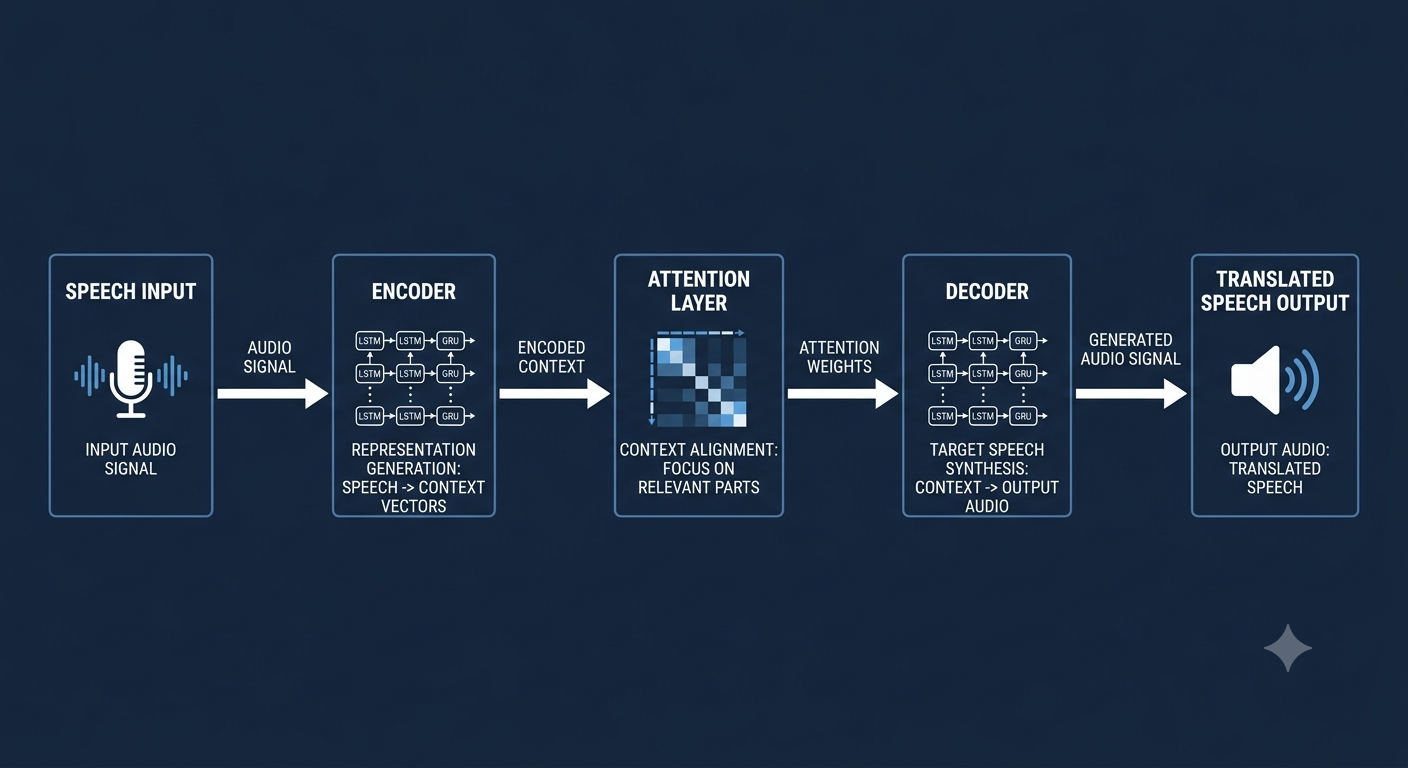
How does an encoder-decoder pipeline translate a sentence?
An encoder-decoder pipeline first "encodes" an input sentence into a numerical representation that captures its meaning, then a "decoder" generates the output sentence in the target language from that representation, word by word, informed by attention over the original input. In a spoken-translation product, this text-level pipeline sits between an automatic speech recognition stage (audio to text) and a text-to-speech stage (text to audio) — the structure covered in more depth in Talky AI Buds' mechanism breakdown.
Why do some language pairs translate better than others?
NMT quality depends heavily on how much bilingual training data exists for a given language pair, so high-resource pairs like English–Spanish or English–French tend to translate more fluently than lower-resource pairs with less available training text. This data-availability gap is a well-documented limitation across the NMT research field, not a flaw unique to any single product, and it is a realistic factor to expect from any 144-language claim, Talky AI Buds included.
What are the known limits of today's NMT systems?
Current NMT systems still struggle with idioms, culturally specific references, and highly ambiguous sentences where meaning depends on context outside the sentence itself. Research surveys on neural machine translation note that fluency has improved dramatically, but perfect accuracy — especially for figurative language — remains an open research problem. This is useful context for setting expectations around any AI translation earbud, including Talky AI Buds, in nuanced or informal conversation.
A note on scope
This article explains neural machine translation as a general, well-documented technology field. It does not claim access to Talky AI Buds' proprietary model architecture, which the manufacturer has not publicly disclosed in detail.