Wireless translation earbuds depend on the same core audio engineering as any true-wireless earbud — microphones, a Bluetooth radio, and digital signal processing — with translation software layered on top. For Talky AI Buds, the quality of this underlying audio hardware directly affects how well the AI translation stages further up the pipeline can perform.
How do earbud microphones capture clean speech?
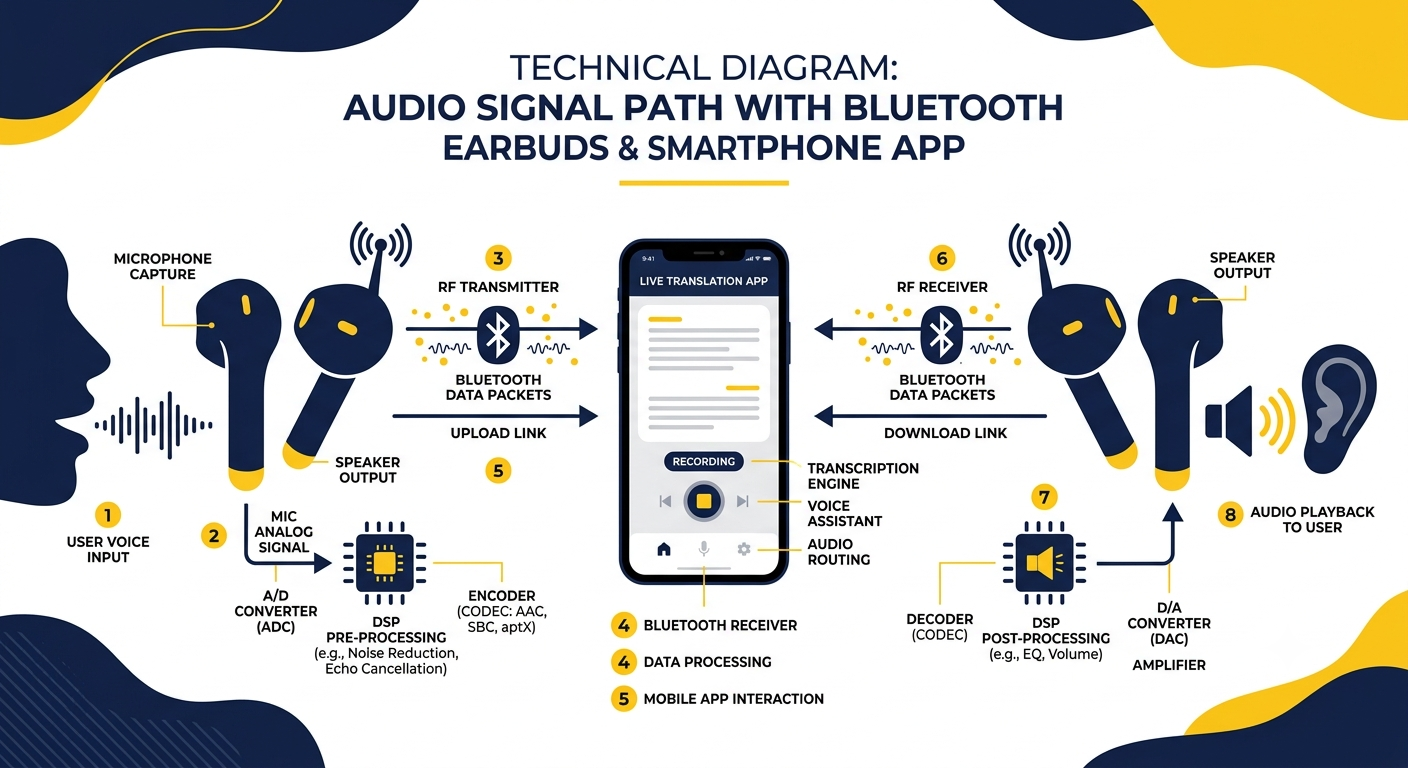
Earbud microphones capture an analog sound wave and convert it into a digital signal, which is then filtered to reduce background noise before being processed further. Many modern earbuds use a small microphone array (multiple mics working together) so that beamforming techniques can help isolate the wearer's voice from ambient sound — a detail relevant to any device, including Talky AI Buds, that depends on accurate voice capture for downstream processing like translation.
What Bluetooth codec is used, and why does it matter?
A Bluetooth audio codec compresses and decompresses digital audio so it can stream wirelessly between the earbud and a phone without a noticeable lag. Codec choice affects both audio fidelity and latency, and the Bluetooth Special Interest Group (SIG) maintains the core specifications that govern range, power use, and connection stability across all Bluetooth earbuds, including translation-focused designs like Talky AI Buds.
Why does latency matter for a translation earbud specifically?
Latency — the delay between speaking and hearing the translated output — matters more for a translation earbud than for a typical music earbud, because conversation feels unnatural if the gap is too long. Every stage in the pipeline (microphone capture, Bluetooth transmission, AI processing, and the return audio stream) adds a small amount of delay, so the cumulative latency budget is one of the harder engineering problems for any real-time speech translation device, Talky AI Buds included.
How does noise cancellation affect translation accuracy?
Noise cancellation and noise-reduction filtering clean up the captured audio signal before it reaches a speech recognition model, and cleaner input generally leads to fewer transcription errors. This is why environment matters: a device like Talky AI Buds should perform more consistently in a quiet room or a calm café than in a loud street or crowded market, regardless of how strong its translation model is.
How does the charging case fit into the system?
The charging case in true-wireless earbuds is both a battery reservoir and a protective, portable storage unit — a detail that matters more for a translation earbud, since AI processing and constant Bluetooth streaming draw more power than passive audio playback. A well-engineered case extends real-world usability across a full day of intermittent conversations, which is part of why battery and case design is covered directly in Talky AI Buds' mechanism breakdown.
A note on scope
This article describes general true-wireless earbud engineering principles publicly documented across the audio industry. It does not represent disclosed internal specifications of Talky AI Buds' hardware, which the manufacturer has not published in technical detail.